There are moments in travel when anticipation shifts into reverence. Standing before 30 Avenue Montaigne, that shift happens quietly. As Principal of Kalu Interiors, Aleem Kassam approaches spaces with a trained eye — attuned to proportion, materiality, and emotional architecture. Yet La Galerie Dior does not invite analysis first. It commands pause.
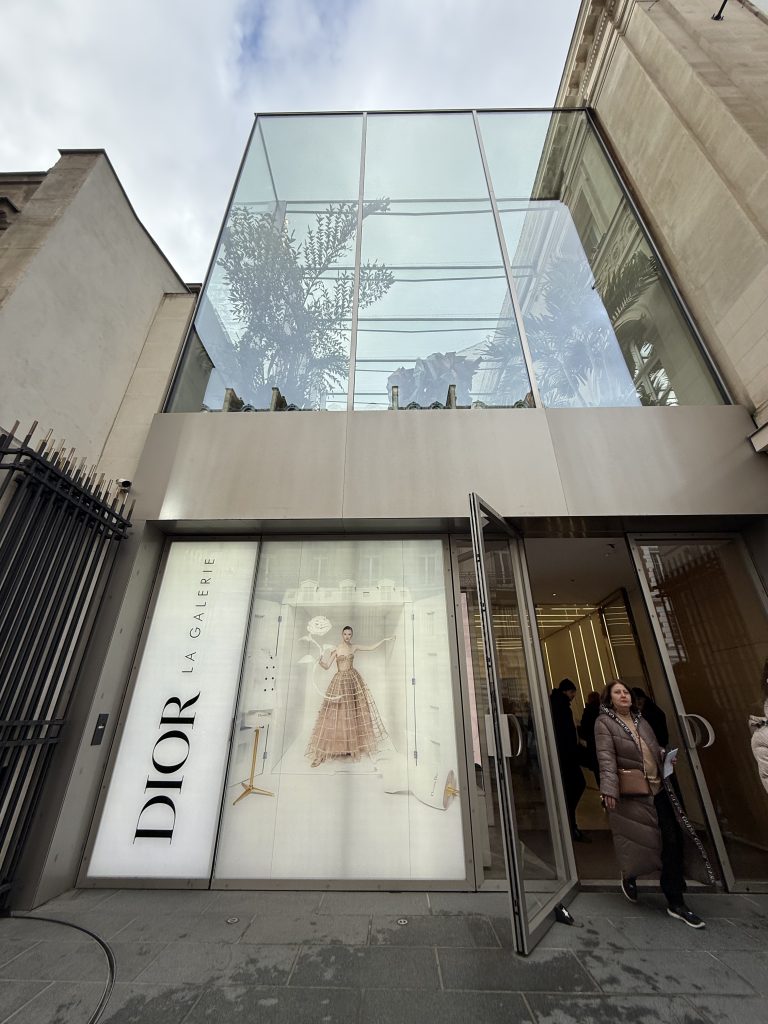
The glass façade rises above the storied hôtel particulier with modern restraint. Through it, silhouettes and palms are faintly visible. The transparency feels intentional, offering only a suggestion of what lies within. The door opens, Paris softens behind, and a different atmosphere takes hold — measured, luminous, intentional. The transition from street to sanctuary is seamless, a study in how architecture can recalibrate mood in a single step.
“When Maison Dior first opened, it had three Ateliers under the eaves of 30 Avenue Montaigne, a tiny studio, a salon in which to show the dresses, a cabine or dressing room for the models, an office, and six small fitting rooms,” recounted Monsieur Dior in his memoirs. For the couturier, it was love at first sight. That sentiment lingers within the newly transformed refuge of the marvelous, where intimacy and grandeur continue to coexist.
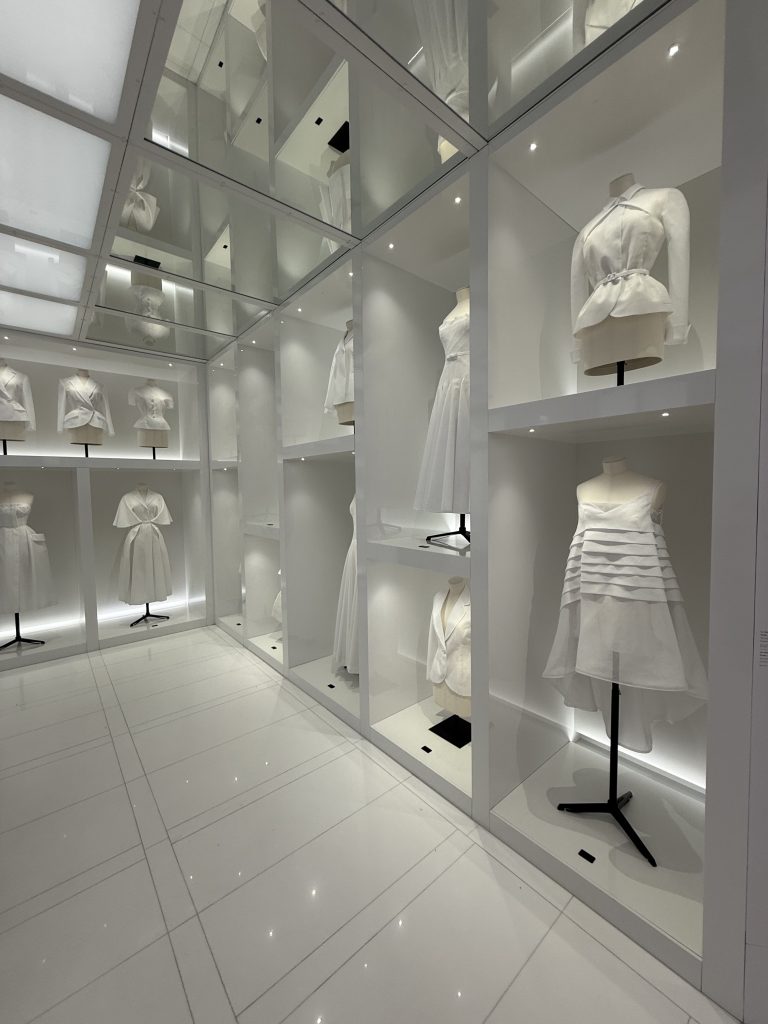
LUMINOUS TAILORING
One of the most striking environments unfolds in a gallery devoted to Dior’s mastery of white. The room is luminous — walls, floor, and ceiling articulated in crisp geometry. Illuminated vitrines house sculptural white jackets and dresses, each form sharp and architectural against the seamless backdrop.
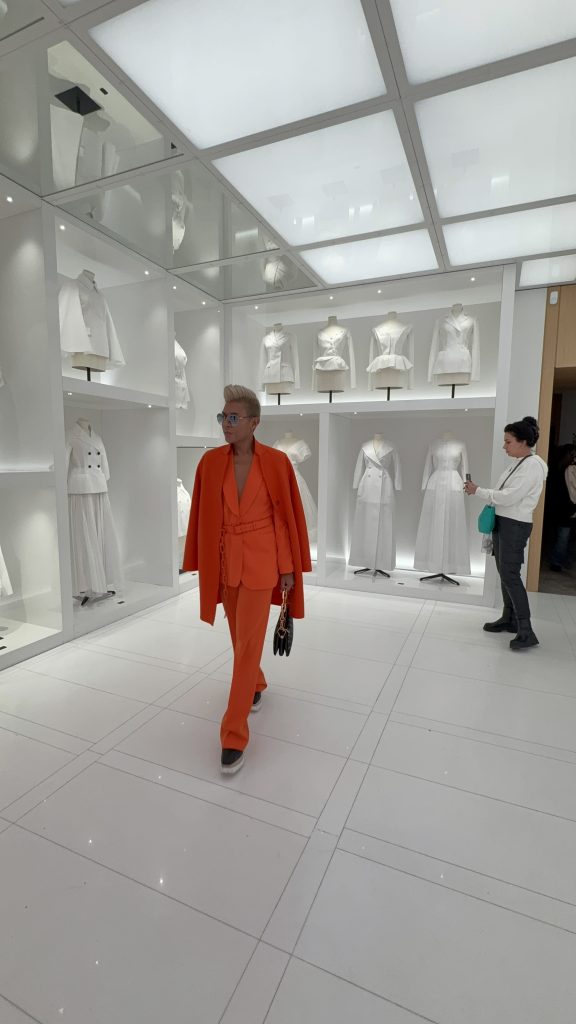
Aleem moves through the space in a Mandarin orange ensemble by Harris Wharf London, the saturated tone introducing warmth into the disciplined neutrality of the gallery. The clean tailoring of the coat, cut with understated precision, mirrors the architectural clarity of the couture pieces surrounding him. Against a field of white, the colour reads not as flamboyant, but intentional — a confident counterbalance to restraint.
The ceiling panels glow softly, mirrored surfaces reflecting repetition and symmetry. Light is diffused rather than directional, eliminating harsh shadow and allowing each seam, fold, and contour to be studied without distraction. It is a study in restraint. White here is not absence; it is power. The tailoring reads like interior millwork — precise, balanced, resolved. For a designer accustomed to orchestrating calm within complexity, the room feels almost meditative. It demonstrates how limitation of palette can amplify form and how negative space can become a primary design element.
Aleem pauses before a double-breasted jacket with sculpted hips, appreciating the subtle tension between softness and structure. In that moment, couture and interior design converge. Both rely on disciplined proportion. Both create confidence through clarity.
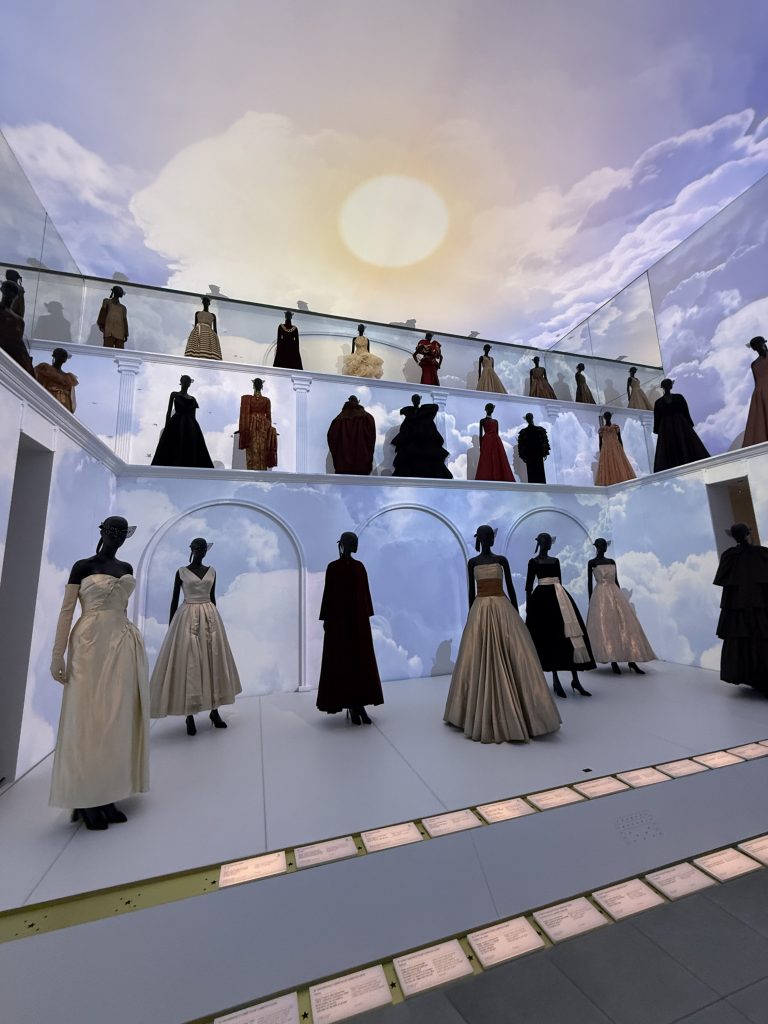
CHROMATIC ASCENT
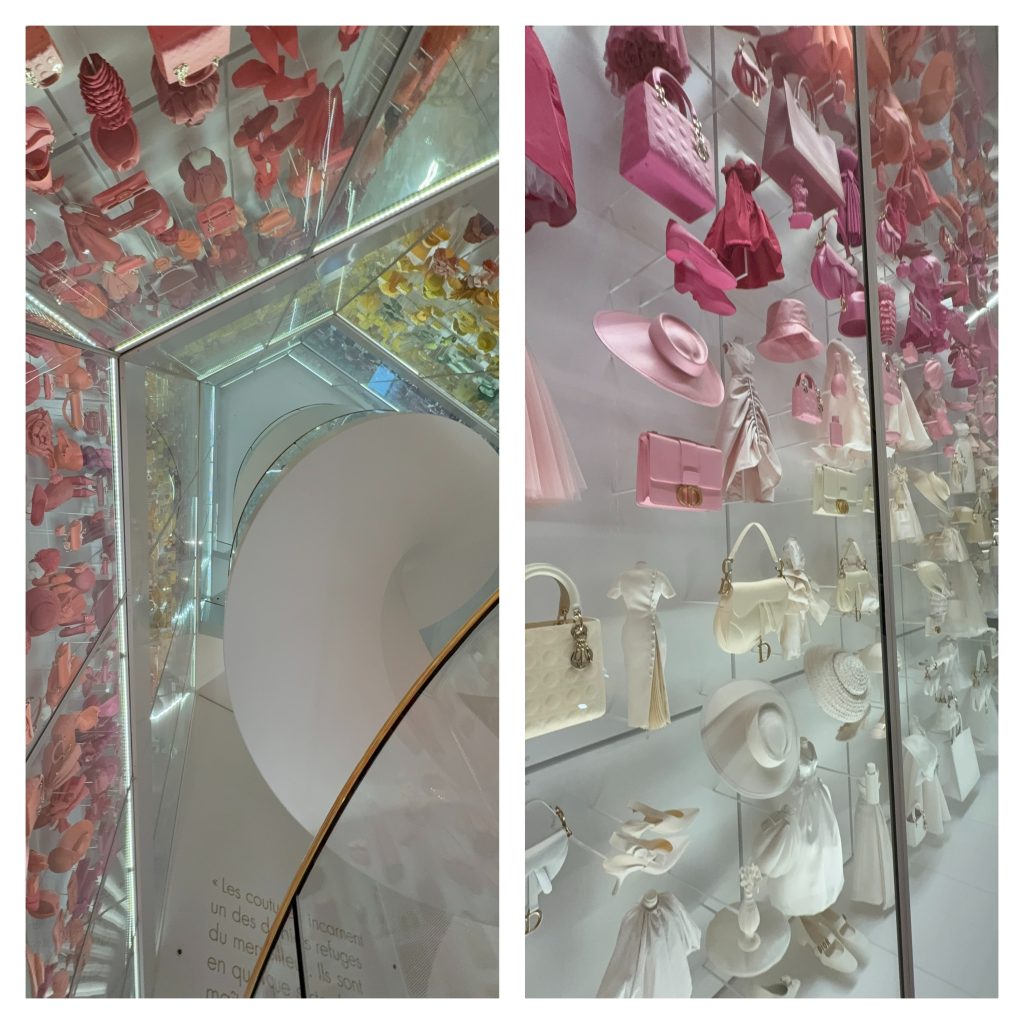
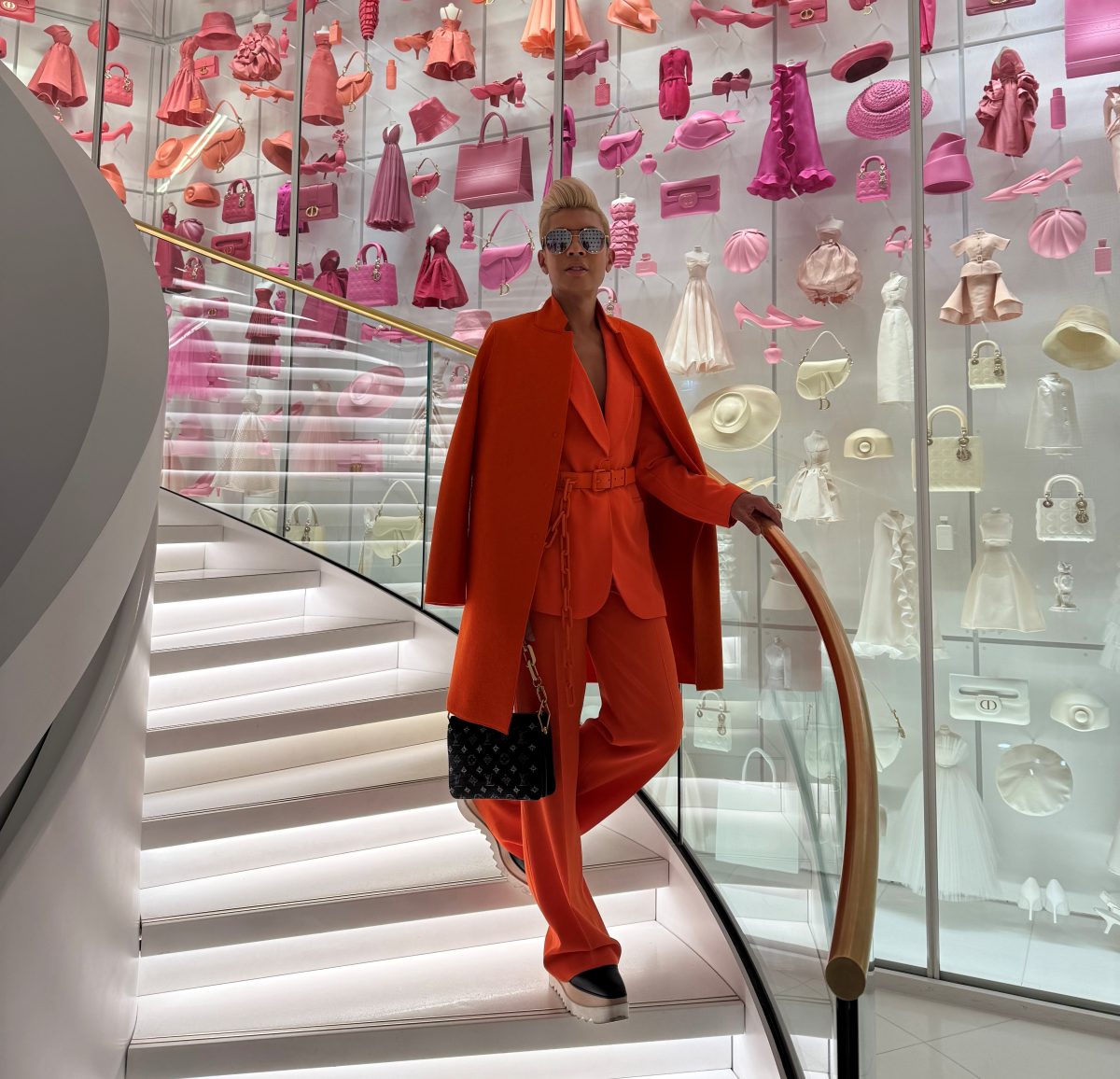
The spiral staircase introduces an entirely different emotional register. White steps illuminated from beneath curve upward with fluid grace, edged in warm metallic detailing. The handrail arcs like a ribbon, guiding movement with quiet elegance.
Behind glass walls, an explosion of colour unfolds. Accessories and garments are suspended in a meticulous gradient — from coral to blush to saturated pink, descending into pale ivory. Hats, handbags, shoes, miniature dresses, and sculptural objects hover in a vertical tapestry of tone. Each item is individually mounted, yet collectively orchestrated into a cohesive chromatic narrative.
Positioned along the staircase, Aleem becomes part of the composition, echoing the deeper corals and warm pinks within the display. The structured silhouette of his look holds its own against the exuberant backdrop, reinforcing the interplay between personal style and curated environment. The moment feels cinematic without excess.
From an interior perspective, the installation demonstrates the power of colour curation and vertical storytelling. Scale shifts from miniature accessory to full garment, yet balance is maintained through disciplined spacing. The white architecture containing the colour ensures that exuberance never feels chaotic. The result is immersive and joyful, a reminder that heritage can be expressed with vitality as well as restraint.
THE HOUSE REIMAGINED
Spanning more than 100,000 square feet, Dior’s flagship has been reinvented as both monument and living archive. Within its labyrinth, La Galerie Dior unfolds across thirteen rooms and three floors, guiding visitors through more than seventy years of creation.
Circulation is seamless. The number of guests is tightly controlled, allowing space for contemplation. Thresholds are carefully staged, sightlines deliberate. As in any successful interior, flow becomes part of the narrative rather than an afterthought.
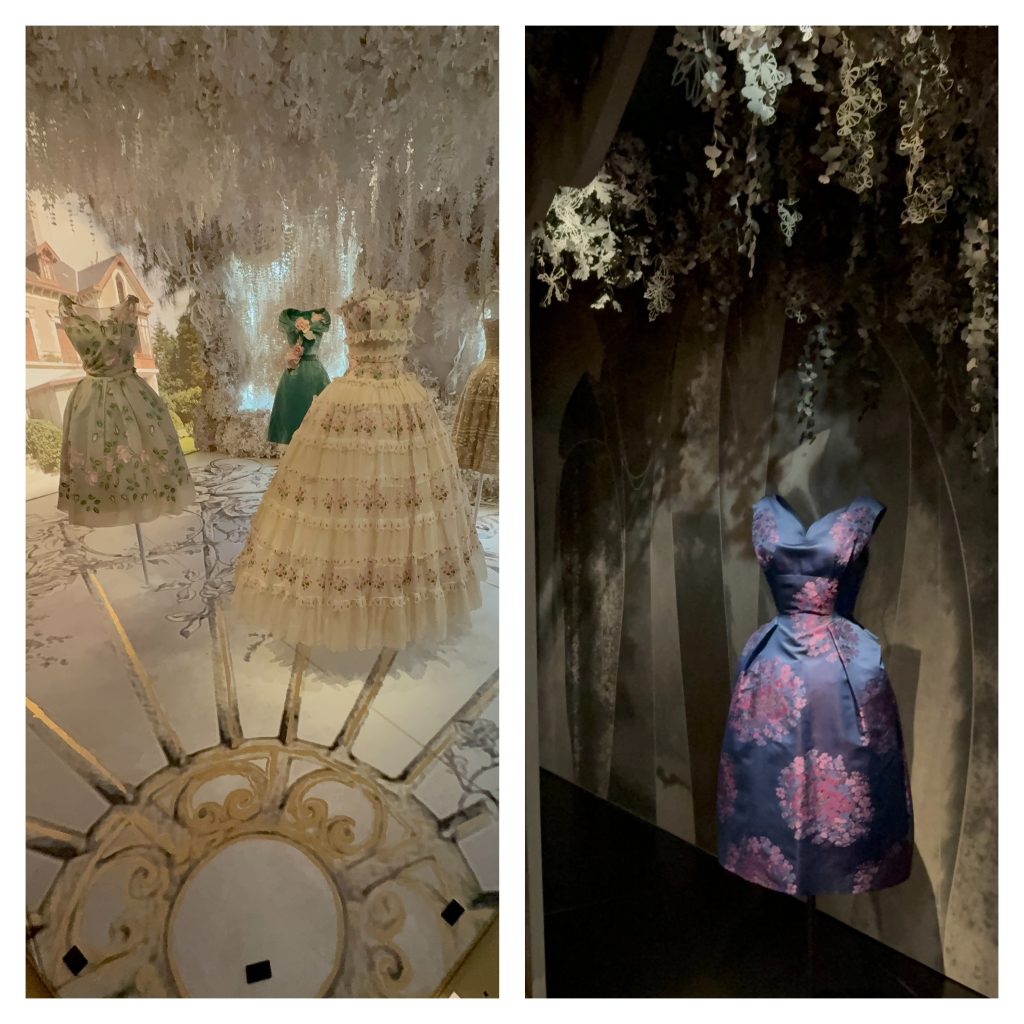
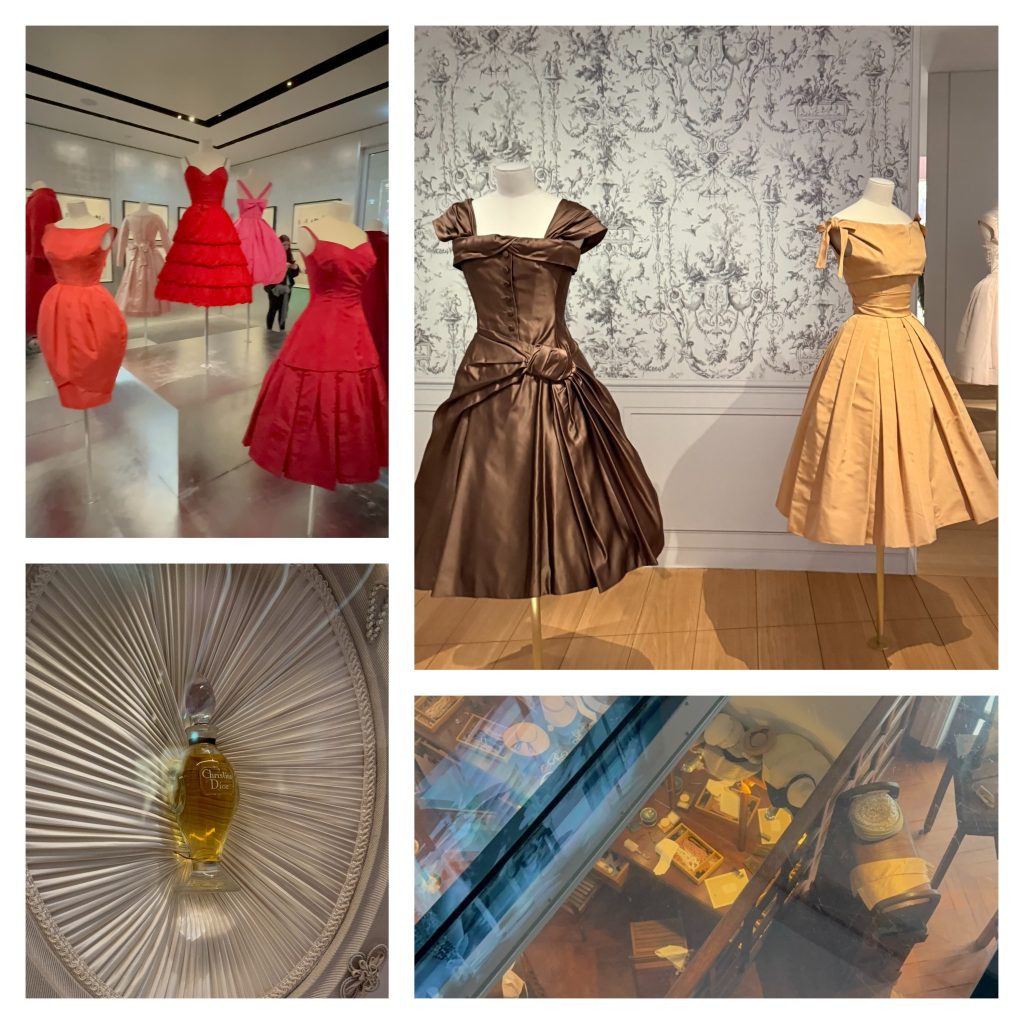
It is within these walls that the Dior Collections have been conceived since the house’s founding. From Christian Dior’s revolutionary New Look to the visions of Yves Saint Laurent, Marc Bohan, Gianfranco Ferré, John Galliano, Raf Simons, and Maria Grazia Chiuri, the lineage is presented not as chronology alone, but as evolution anchored in identity. Archival garments, original sketches, and exceptional pieces form a dialogue between past and present, reinforcing continuity rather than nostalgia.
FUTURE IN VIEW
Stepping back onto Avenue Montaigne carries a different weight. The journey through La Galerie Dior is not simply retrospective. It sharpens perception. It clarifies what heritage truly means when it is expressed through space and sustained through reinvention.
For Aleem, the visit extends beyond Paris. Dior is confirmed to be among the 100 boutiques featured in the luxury retailer lineup at Oakridge Park in Vancouver. That knowledge reframes the experience entirely.
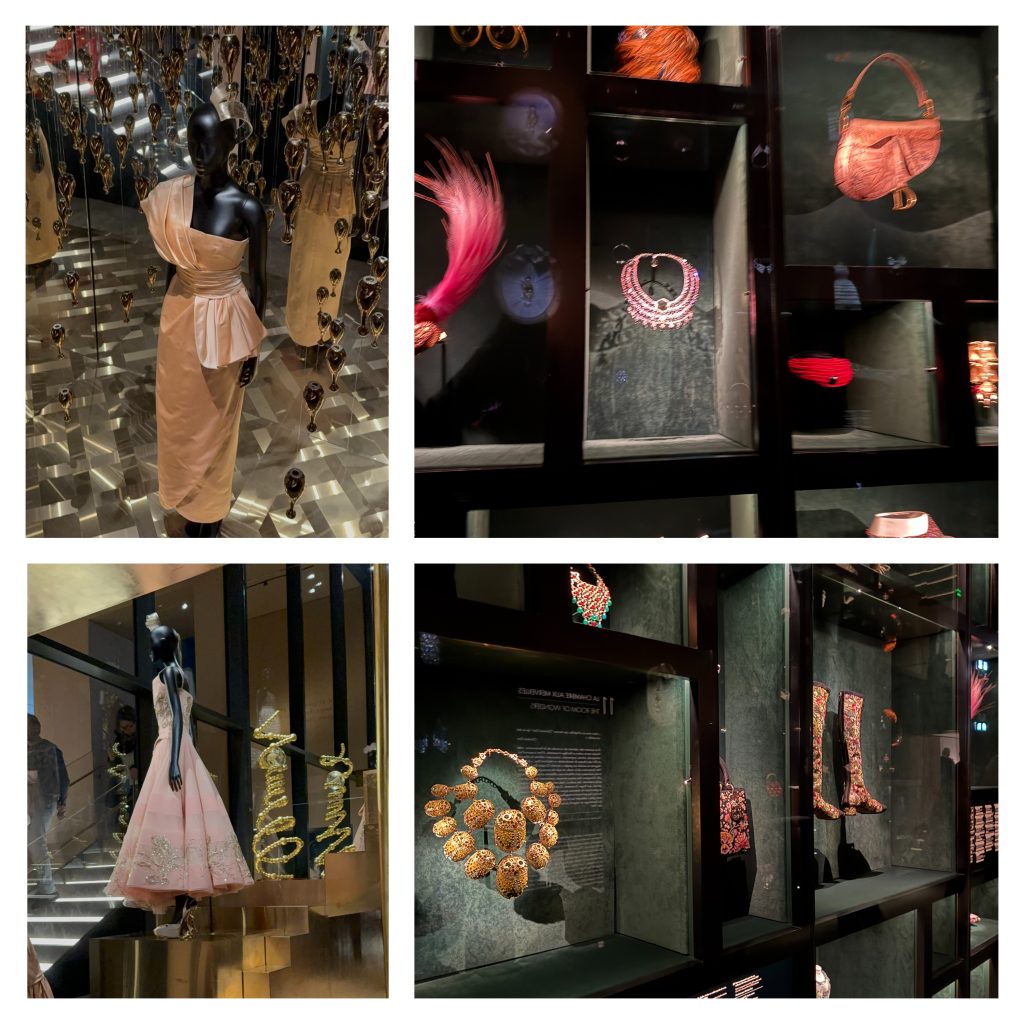
Having walked through the modest origins under the eaves, witnessed the evolution of creative directors, and stood within rooms where white discipline and chromatic exuberance coexist, anticipation becomes layered. The forthcoming boutique at Oakridge Park will not be viewed as a store alone. It will be interpreted as continuation — an architectural expression of a house that understands the power of environment.
Oakridge Park signals a new chapter in Vancouver’s luxury narrative — an environment where global maisons will articulate identity within a distinctly West Coast context. After experiencing Dior’s beating heart at 30 Avenue Montaigne, the expectation deepens. A journey into the past heightens appreciation for what is yet to be unveiled.
The refuge of the marvelous moves forward, carrying memory with it. And in that continuity lies the anticipation now felt in Vancouver, as Oakridge Park prepares to welcome a house whose legacy continues to shape both space and imagination.
Author Profile

- Helen Siwak is the founder of EcoLuxLuv Communications & Marketing Inc and publisher of Folio.YVR Luxury Lifestyle Magazine and PORTFOLIOY.YVR Business & Entrepreneurs Magazine. She is a prolific content creator, consultant, and marketing and media strategist within the ecoluxury lifestyle niche. Helen is the west coast correspondent to Canada’s top-read industry magazine Retail-Insider, holds a vast freelance portfolio, and consults with many of the world’s luxury heritage brands. Always seeking new opportunities and challenges, you can email her at [email protected].
Latest entries
 ☆ Issue #39 - Feb 2026March 7, 2026From La Galerie Dior in Paris to the Anticipation of Dior at Oakridge Park
 ☆ Issue #39 - Feb 2026March 7, 2026Angela Grossmann: Restoring Forgotten Lives and Reclaiming the Female Form Across Four Decades
 ☆ Issue #39 - Feb 2026March 7, 2026Mario Bemer: Florentine Mastery Arrives in Vancouver
 ☆ Issue #39 - Feb 2026March 7, 2026CELEBRATE: Shunzi & Jordan: A Summer of Light, Legacy, & Love at Fairmont Pacific Rim