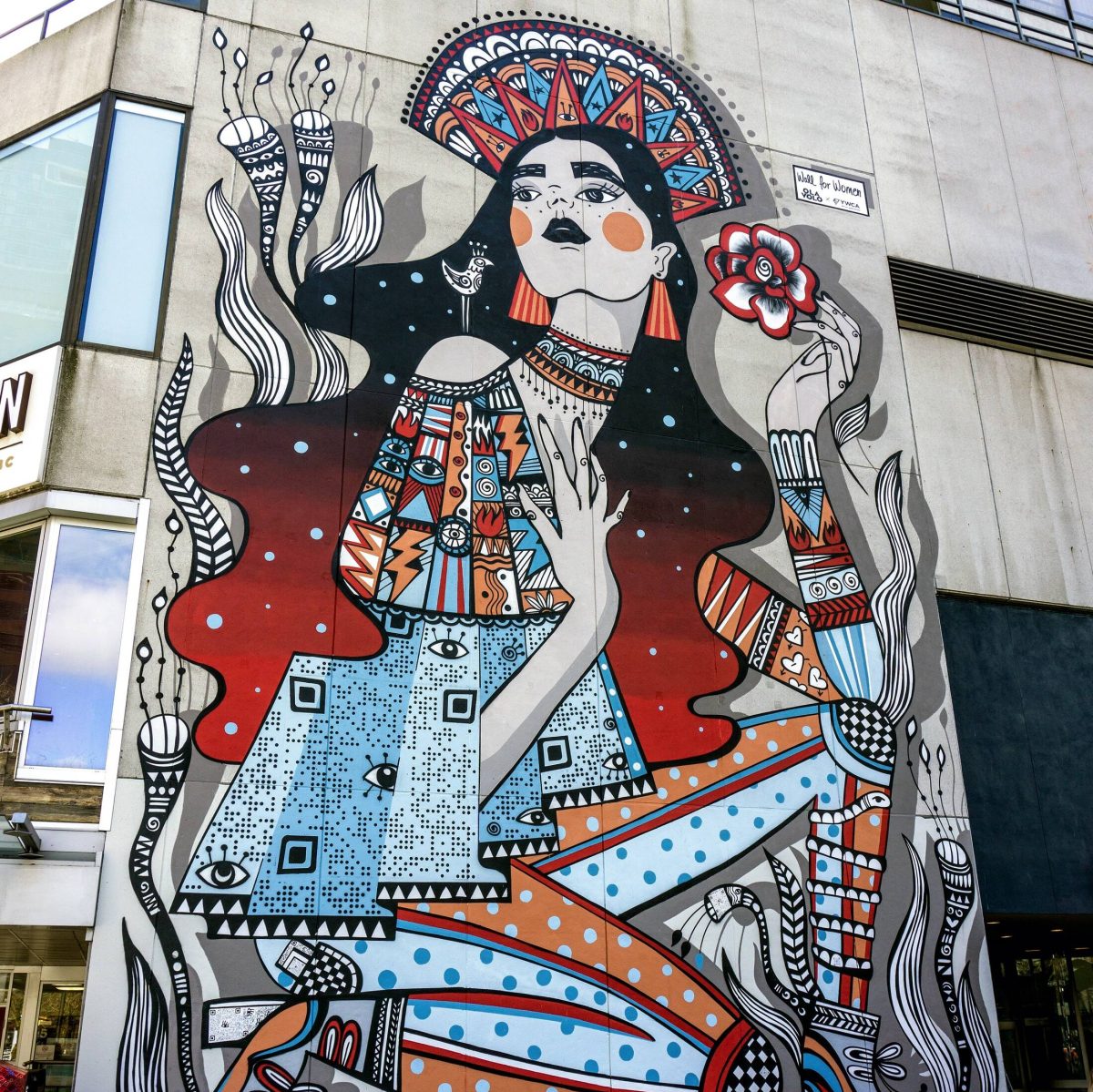
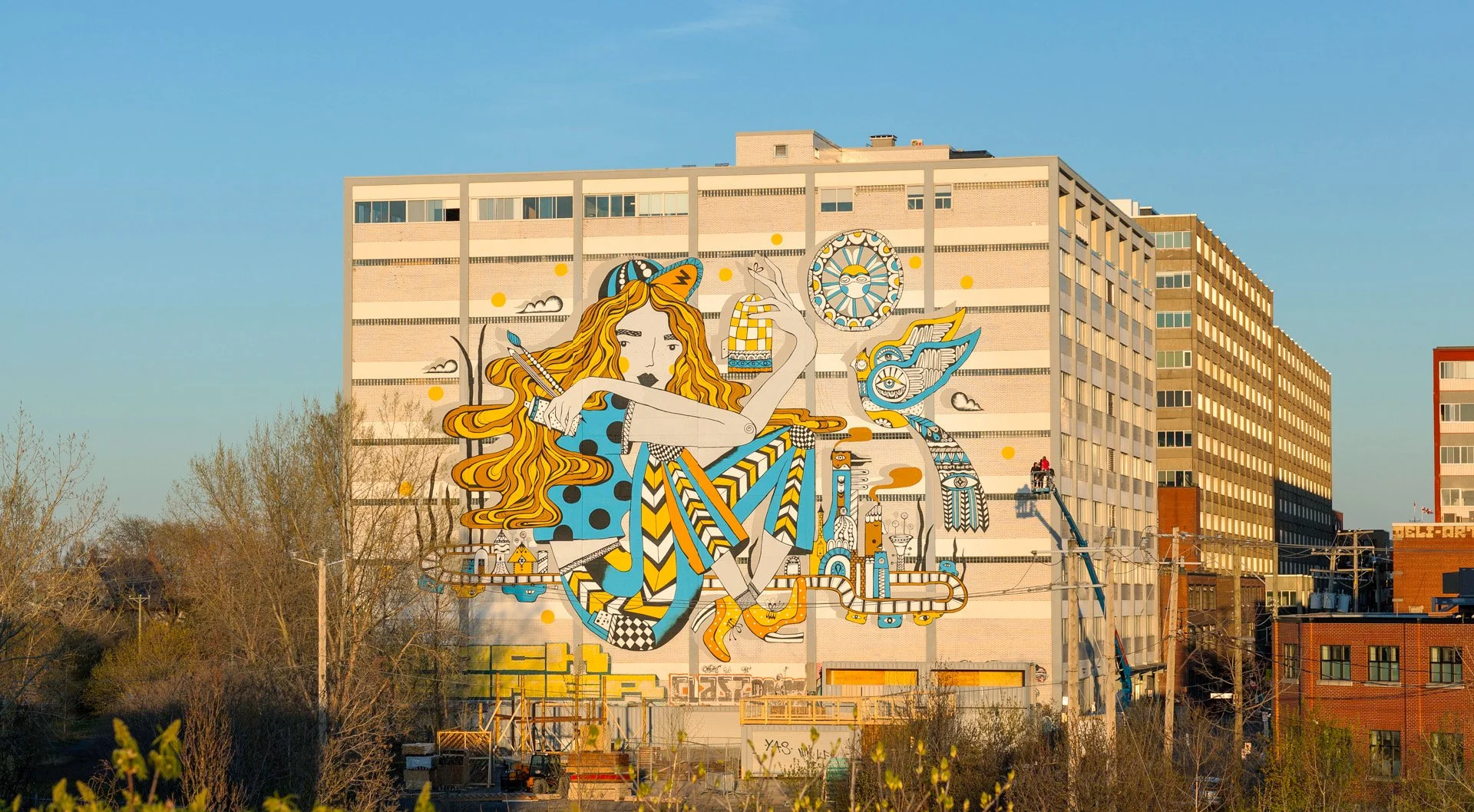
At the corner of Burrard Street and Melville Avenue in downtown Vancouver, a queen rises. She does not demand attention so much as draw it — the way certain presences do, quietly and then all at once. She is nearly 13 metres tall, crowned and ornamented in the visual language of Central Asian folk tradition, her gaze turned not inward but outward, toward something that has not yet arrived but is already on its way. She holds a rose. She holds her ground. Around her, symbols of bravery and transformation unfurl in colour that pulses against the concrete face of the Hyatt Regency Hotel, visible to thousands of people who pass beneath her every single day — most of them never knowing she was painted in 2021 as an act of advocacy. A wall for women. Painted for peace.
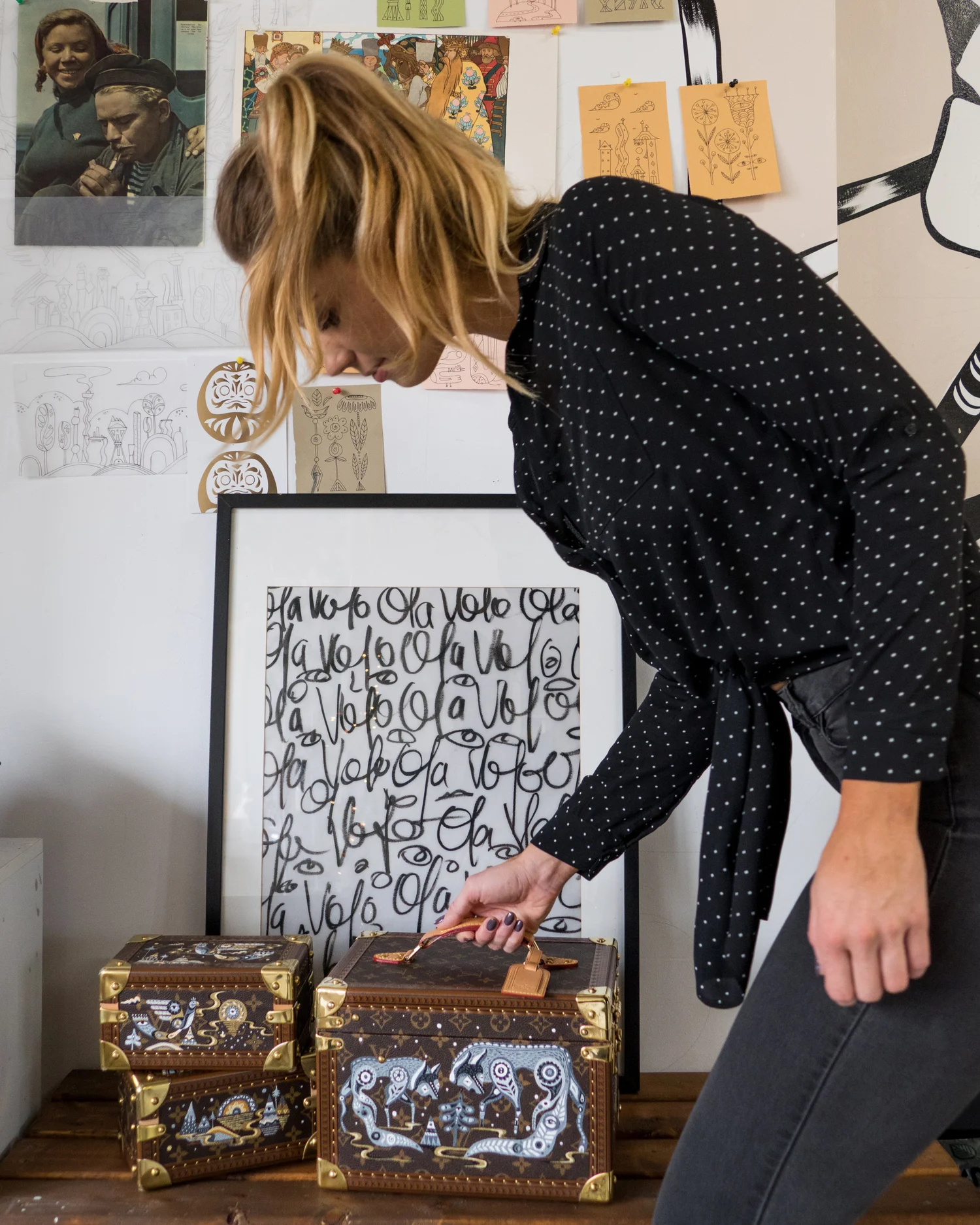
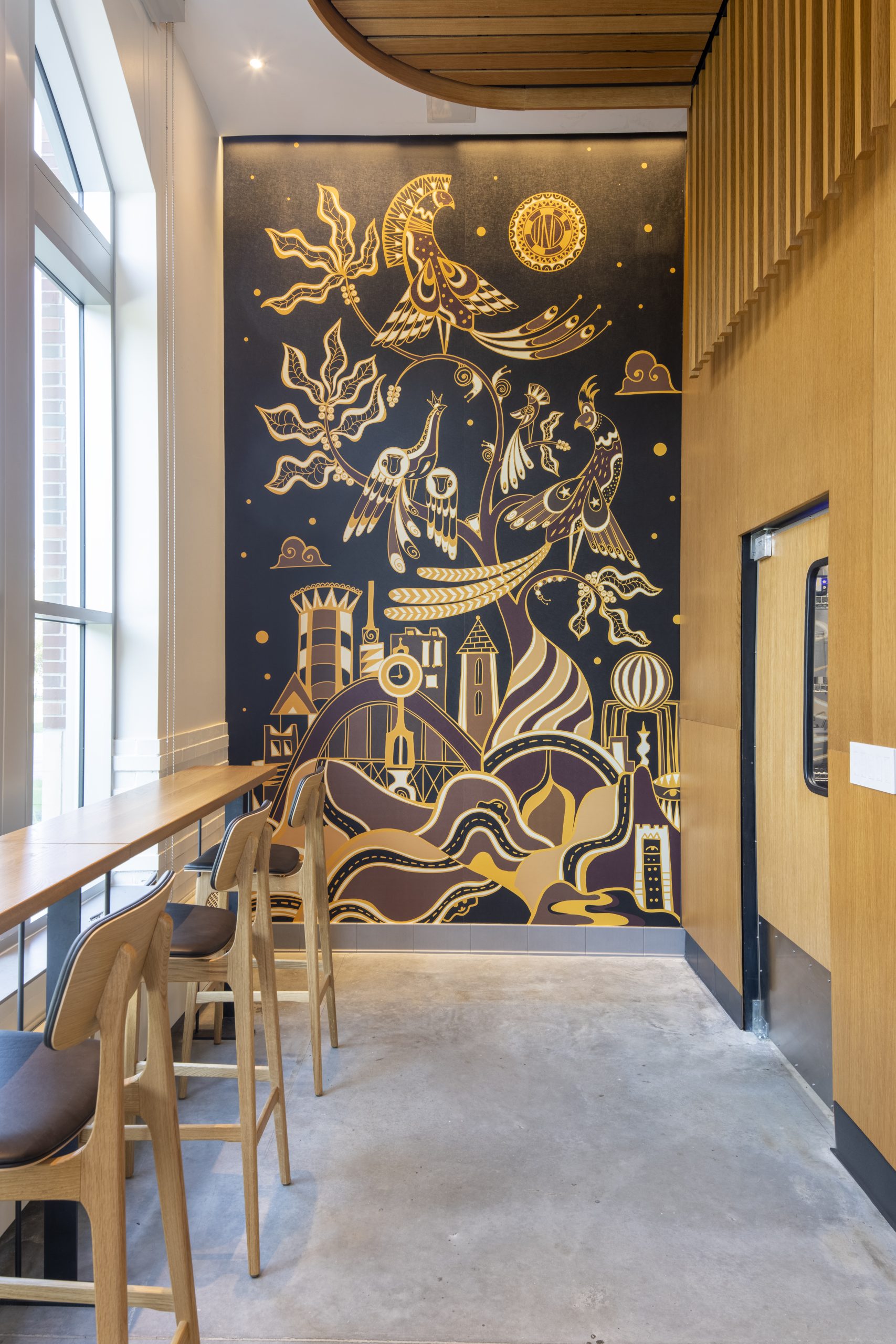
The mural was commissioned by the YWCA to raise awareness of gender-based violence, to connect women in crisis to resources, and to offer something that policy documents and pamphlets cannot: the dignity of being seen. To execute it, the YWCA called on Ola Volo, an artist who lives between Vancouver and Montreal, whose work had by then already climbed building facades across Canada and Europe, graced the hand-painted surfaces of Louis Vuitton trunks, and on the walls of over a dozen Starbucks in North America including Disneyland. She was the right artist. She was, in many ways, the only artist.
BEFORE WORDS
Ola Volo grew up in Kazakhstan surrounded by folklore, ornament, and a visual culture that lived in the body before it was ever named. She carried those stories with her when she immigrated to Canada, carried them through her studies at Emily Carr University of Art + Design in Vancouver, and has carried them onto every wall she has painted since. They are not deployed as decoration or ethnic signifier. They are, as she describes it, an emotional language — one that travels across borders because it was never anchored to a single location to begin with.
“My work is rooted in my own visual memory,” she says. “For me, it is less about illustrating my heritage literally and more about bringing its emotional language into conversation with a place. The themes I return to — beauty, resilience, femininity, nature, transformation, community — are deeply personal to me, but also universal.”
Emily Carr gave her a critical framework to match the instincts she already possessed. But she is clear about the limits of formal education. “There were things I carried with me that no formal education could really give me. My sense of ornament, symbolism, and narrative came from much earlier — from childhood, from immigration, memory, and the visual culture that surrounded me before I even had language for it. School helped me refine my voice, but the deeper pulse of the work came from lived experience.”
THE SCALE OF IT
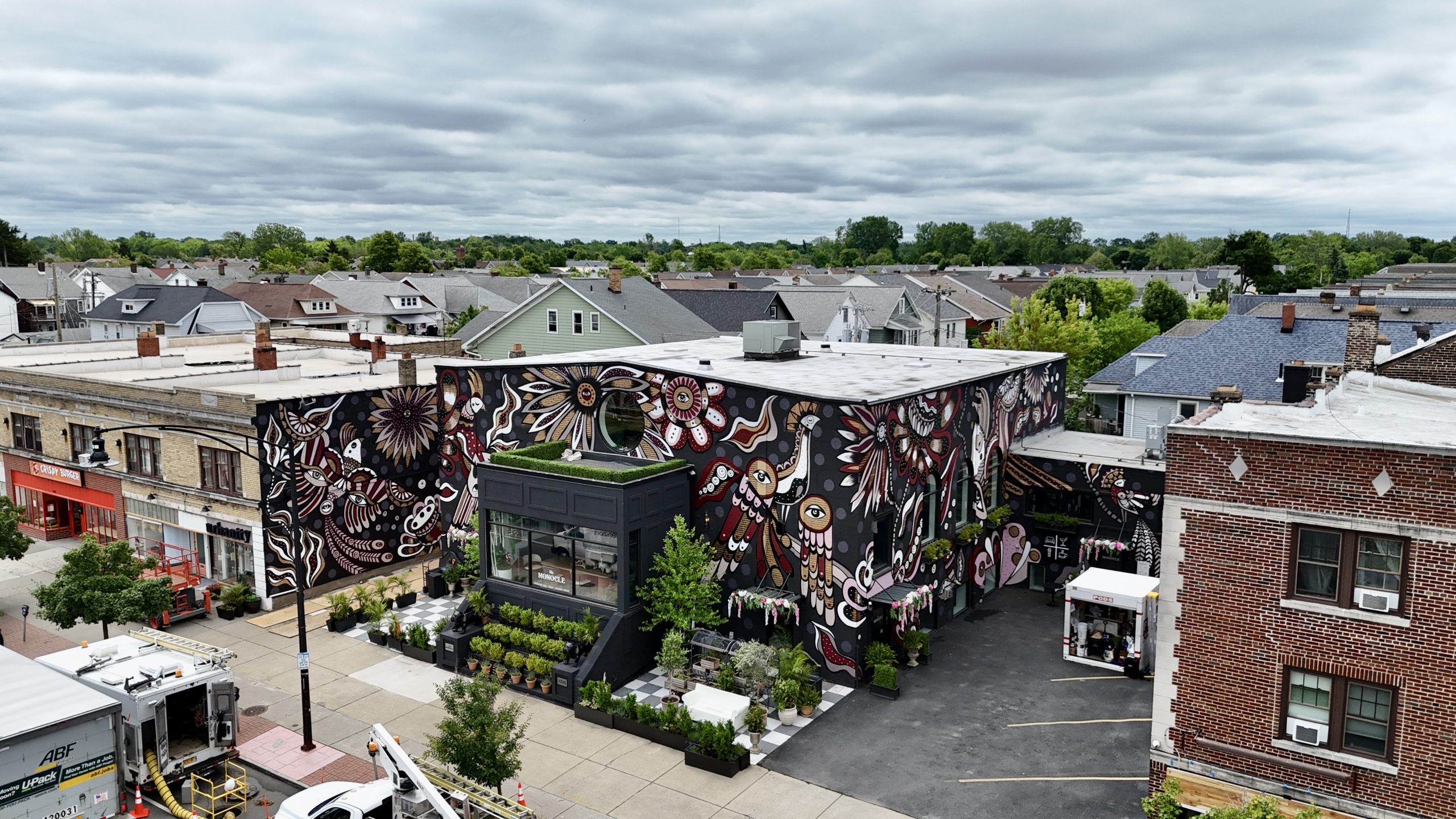
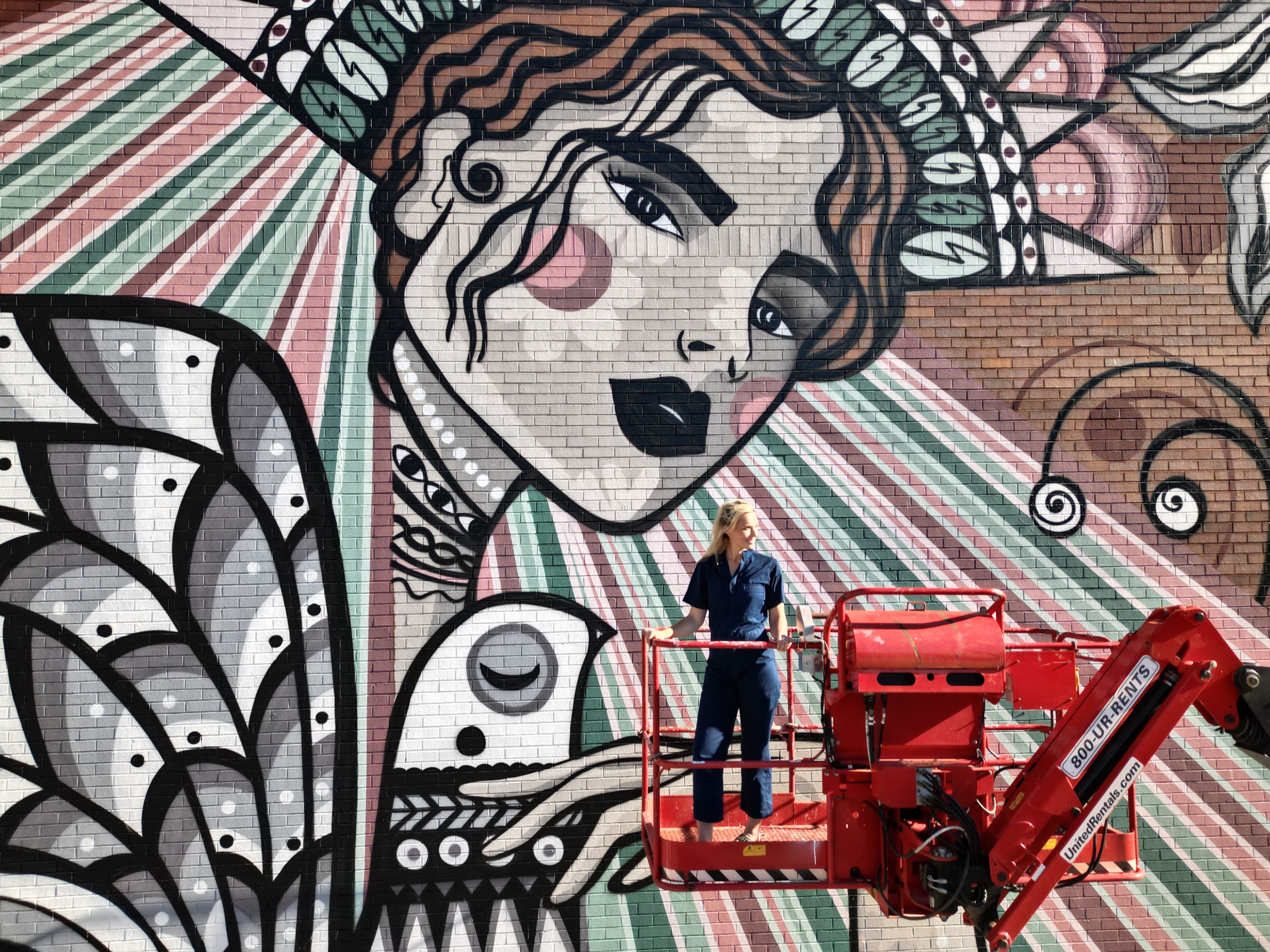
There is a paradox at the centre of Volo’s mural practice: the larger the work, the more intimate it feels. Her figures do not recede into scale. They advance. Stand beneath the YWCA queen on Burrard Street and the detail holds — the beadwork, the birds, the ornamental halo of pattern radiating around her crown. Drive past at speed and the silhouette is unmistakable. Both distances are true at once.
“Even when I am working at a massive scale, I still want the piece to feel close,” she explains. “I want someone to be able to take it in from blocks away, but also to discover smaller moments, symbols, and relationships when they stand right in front of it. That layered experience is really important to me.”
The physical reality of working at building scale is its own kind of reckoning. Weather, lifts, changing light, the architecture interrupting the composition — all of it becomes part of the creative process. “Some days it even feels a bit performative,” she admits. What remains constant is the intention underneath: that the work, once installed, will live with people. Will age with a neighbourhood. Will ask something of those who pass it every morning without quite knowing why.
WITHOUT BORDERS
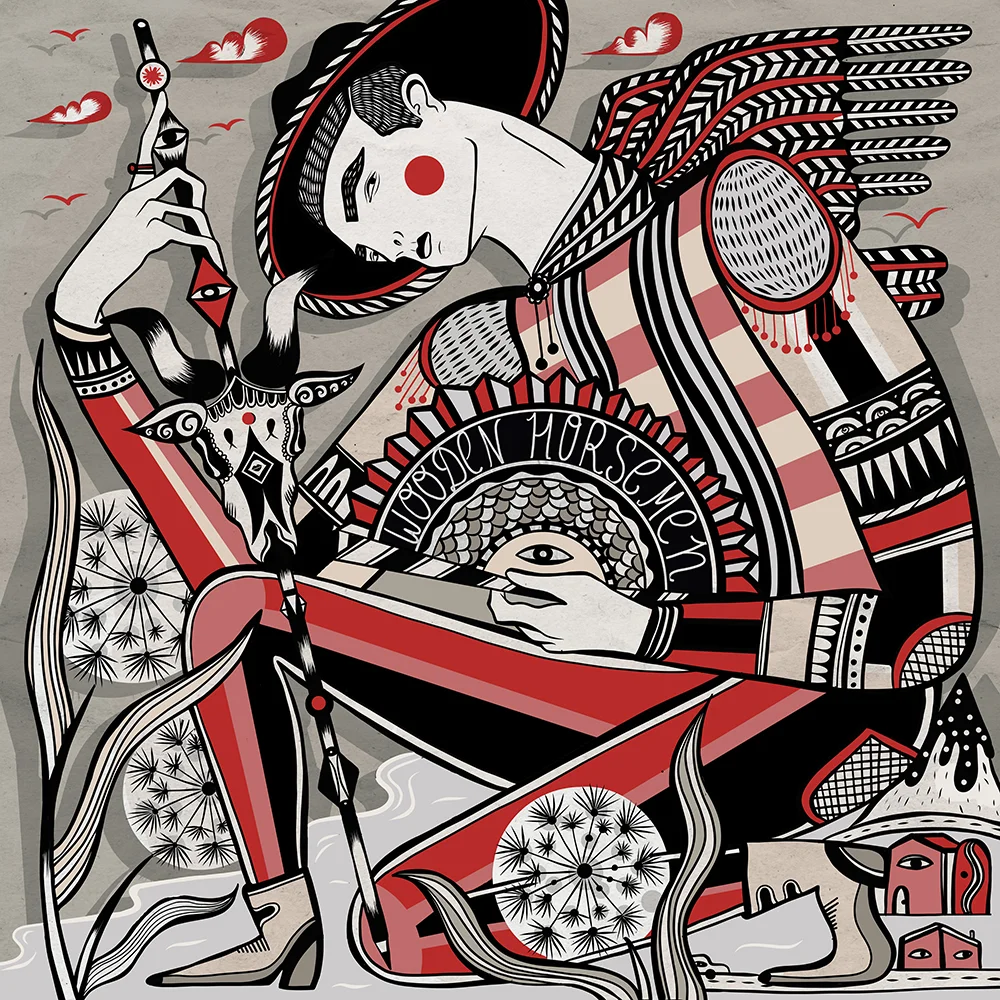
Volo’s commercial work carries the same authorial weight as her public murals. The hand-painted Louis Vuitton trunks — each one a small world of mythological creatures and celestial landscapes rendered in her unmistakable palette — feel less like branded objects than like artefacts. An album cover rendered in deep red and black ink, figures coiling through symbolic narrative, reads like the cover of a book that has not yet been written. These are not commissions that asked her to become something else. They are commissions that sought her out precisely because of what she already was.
“The best collaborations happen when a client is drawn to my visual language because they genuinely connect with it,” she says, “not because they want to reshape it into something unrecognizable.” She names trust as the deciding factor. “Interestingly, some of the biggest brands I have worked with have been some of the easiest because there was a real sense of trust. That said, getting to that point was a learning curve. Over the years, I have learned how important it is to ask the right questions during the briefing stage and to brainstorm together early on.”
There is a line, and she knows exactly where it falls. “If the work starts losing its soul, becomes overly diluted, over-directed, or disconnected from what I actually do — that is when it becomes compromise. And usually when I lose the spark.”
WHAT THE WALL HOLDS
Back on Burrard Street, the queen endures. She has weathered Vancouver rain and low winter light. She has been photographed by tourists who did not know her name and walked past by commuters who have stopped seeing her entirely — until one day, they do not. That is the nature of public art when it is made with this kind of care. It waits. It holds. It asks its question again.
The YWCA mural was one of the most challenging projects Volo has undertaken. “Through that project, I not only learned a lot from the organization, but also had the chance to connect with women who were directly part of it. We painted together, they shared their stories with me, and that was incredibly moving.” The final work went through many rounds of revision to ensure it carried both empowerment and education. What arrived on the wall was not a beautiful gesture. It was an answer.
“For me, a successful outcome is not just that the piece is visually strong,” she reflects. “It is that people feel seen in it. It is that the artwork opens conversation, creates dignity, and leaves behind a sense of care rather than just branding. Aesthetic power matters, but it has to serve something deeper.”
Up on that concrete face, the queen looks toward the horizon. She has been looking there since 2021. She will keep looking long after the scaffolding is gone, long after the city has changed around her — and long after the hand that painted her has moved on to the next wall, the next story, the next surface that needed a voice.
That next chapter arrives in September 2026, when Volo opens a solo gallery exhibition in Calgary. No client brief. No brand parameters. No architecture to negotiate. Just the work, and the questions she has been sitting with. “What is new here? What have I learned in the past few years? How does femininity shift after becoming a mother? What changes when no client is involved at all?” She describes the process as exciting, but does not romanticize it. “It has been honestly much harder than commissioned work.”
It is a different kind of pressure — the kind that has no external structure to push against, no deadline born of someone else’s campaign cycle. The gallery show asks her to account for her own evolution, to look at what the visual dictionary she has spent years building actually says now, and whether it has grown somewhere new. For an artist whose work has always carried the weight of transformation, that is perhaps the most fitting question of all.
Author Profile

- Helen Siwak is the founder of EcoLuxLuv Communications & Marketing Inc and publisher of Folio.YVR Luxury Lifestyle Magazine and PORTFOLIOY.YVR Business & Entrepreneurs Magazine. She is a prolific content creator, consultant, and marketing and media strategist within the ecoluxury and luxury lifestyle niches. Helen is the west coast correspondent to Canada’s top-read business magazine Retail-Insider, holds a vast freelance portfolio, and is an EIC for Hire. Connect with her here: [email protected].
Latest entries
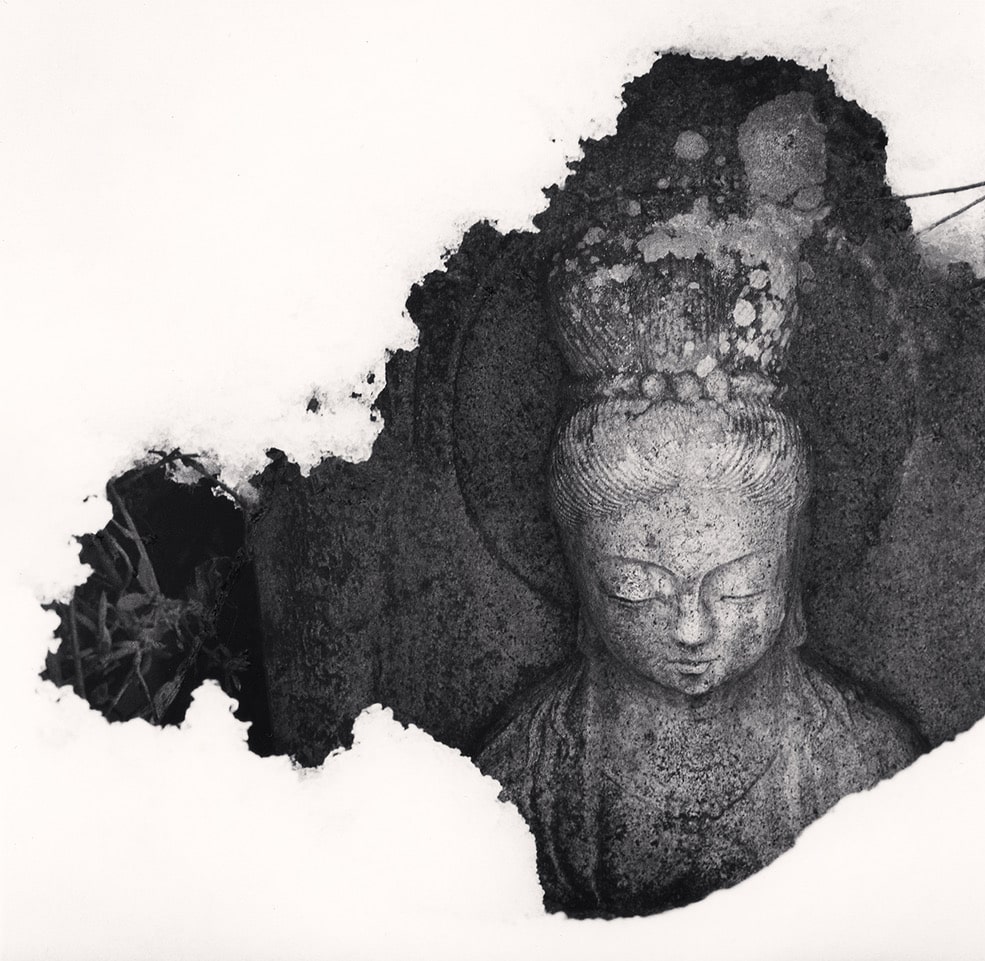 FoF ☆ Arts & CultureOctober 13, 2026From a Business Card to a Seven-Year Partnership: Michael Kenna and Kostuik Gallery
 FoF ☆ Culinary, Wine, SpiritsOctober 13, 2026Canada’s Great Kitchen Party Celebrates 20 Years With a Vancouver All-Star Invitational
 FoF ☆ Charity & PhilanthropyOctober 12, 2026Dinners Are Sold Out, But Vancouver Entertains Is Just Getting Started
 ☆ Issue #43 - September 2026October 10, 2026The Stylist Who Is Ready to Talk: Michelle Addison Goes Independent